Posts

Showing posts with the label CrowdStrike

CrowdStrike update crashes Windows systems, causes outages worldwide

Image
By Ionut Ilascu,  Bleeping Computer A faulty component in the latest CrowdStrike Falcon update is crashing Windows systems, impacting various organizations and services across the world, including airports, TV stations, and hospitals. The glitch is affecting Windows workstations and servers, with users reporting massive outages that took offline entire companies and fleets of hundreds of thousands of computers. According to some reports, emergency services in the U.S. and Canada have also been impacted. Worldwide outage By the time of the correction, though, many large organizations across multiple verticals had already been affected. Some reports say that CrowdStrike’s update impacted some 911 emergency service agencies in the state of New York (EMS, police, fire department), Alaska, and Arizona, as well as 911 services in parts of Canada. A 911 telecommunicator in Illinois said that they were “working off of paper until things come back.” There also reports that the health hotlin...

Major Microsoft 365 outage caused by Azure configuration change

Image
By Sergiu Gatlan,  Bleeping Computer Microsoft says an Azure configuration change caused a major Microsoft 365 outage on Thursday, affecting customers across the Central US region. This massive outage started around 6:00 PM EST and prevented users from accessing various Microsoft 365 apps and services. The list of services impacted by the outage includes Microsoft Defender , Intune, Teams, PowerBI, Fabric, OneNote, OneDrive for Business, SharePoint Online, Windows 365, Viva Engage, Microsoft Purview, and the Microsoft 365 admin center. Xbox Support confirmed that the Xbox Live service was also hit by the issue, saying gamers had problems logging into their accounts. Throughout the outage, Downdetector has received tens of thousands of service issue reports, with affected Xbox users experiencing server connection issues and saying they couldn't log in. After acknowledging the outage, Microsoft said, "We're working on rerouting the impacted traffic to alternate systems to ...

Russian state hackers swap malware with cloud-based attacks

By Vilius Petkauskas,  Cybernews Russian adversaries increasingly focus on targeting the cloud environment, Crowdstrike’s Global Threat Report on Cloud Security revealed. Fancy Bear, a Russian adversary associated with Russia’s Main Intelligence Directorate (GRU), used to rely on malware-based spear-phishing attacks, the report claims. However, with their tactics exposed by the US Department of Justice (DoJ), hackers have refocused their attention on cloud service providers. Since Fancy Bear’s primary source of intelligence comes from various credential harvesting practices that allow penetrating target organizations and individuals, it’s no surprise that the main targets are cloud-based email providers. According to the report, Fancy Bear focused their attention on service providers such as Microsoft 365, Google’s GSuite, as well as webmail providers that individuals usually use. Meanwhile, Cozy Bear, Russia’s state-sponsored hacker group controlled by the Federal Security service...

Good Luck Not Accidentally Hiring a North Korean Scammer

DPRK hackers are tricking their way into jobs with Western firms. A US government alert reminds employers they're on the front lines—and potentially on the hook. By Lily Hay Newman, Wired For more than a decade, North Korean hackers and digital scammers have run wild, pilfering hundreds of millions of dollars to raise funds for the Hermit Kingdom and often leaving chaos in their wake. But while the United States and other governments regularly call out North Korea’s digital espionage operations and issue indictments against their hackers, it has proved more difficult to bring charges for rogue theft and profiteering. North Korea has been under extensive sanctions by the US and other governments for years, but efforts to address the regime’s financial crimes have met with obstacles.  Last week, the US Treasury, State Department, and Federal Bureau of Investigation jointly issued a 16-page alert warning businesses to guard against a particular scam in which North Korean IT workers ap...

Microsoft detects massive surge in Linux XorDDoS malware activity

Image
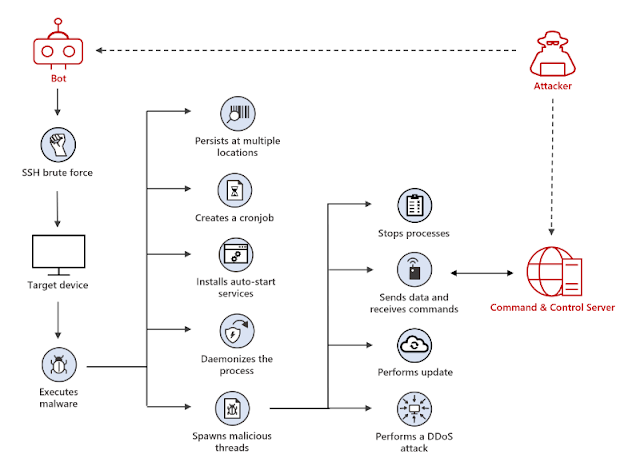
By Sergiu Gatlan, Bleeping Computer A stealthy and modular malware used to hack into Linux devices and build a DDoS botnet has seen a massive 254% increase in activity during the last six months, as Microsoft revealed today. This malware (active since at least 2014) is known as XorDDoS (or XOR DDoS) due to its use of XOR-based encryption when communicating with command-and-control (C2) servers and being employed to launch distributed denial-of-service (DDoS) attacks. As the company revealed, the botnet's success is likely due to its extensive use of various evasion and persistence tactics which allow it to remain stealthy and hard to remove. "Its evasion capabilities include obfuscating the malware's activities, evading rule-based detection mechanisms and hash-based malicious file lookup, as well as using anti-forensic techniques to break process tree-based analysis," Microsoft 365 Defender Research Team said. "We observed in recent campaigns that XorDdos hides m...

Pro-Ukraine hackers use Docker images to DDoS Russian sites

Image
By Bill Toulas,       Bleeping Computer Docker images with a download count of over 150,000 have been used to run distributed denial-of-service (DDoS) attacks against a dozen Russian and Belarusian websites managed by government, military, and news organizations. Behind the incidents are believed to be pro-Ukrainian actors such as hacktivists, likely backed by the country's IT Army. DDoS cyberattacks aim to cripple operations of by sending out more requests than the target can handle and becomes unavailable to legitimate clients. Targeting Docker APIs Among the 24 domains targeted include that of the Russian government, the Russian military, and Russian media like the TASS news agency. Two Docker images involved in the attacks were spotted by threat researchers at cybersecurity company CrowdStrike, who observed them being deployed between February and March 2022. Targeting exposed Docker APIs isn’t anything novel, as cryptocurrency mining gangs like Lemon_Duck and Te...