Posts

Showing posts with the label Ransomware

Dark Angels ransomware receives record-breaking $75 million ransom

Image
By Lawrence Abrams,  Bleeping Computer A Fortune 50 company paid a record-breaking $75 million ransom payment to the Dark Angels ransomware gang, according to a report by Zscaler ThreatLabz. "In early 2024, ThreatLabz uncovered a victim who paid Dark Angels $75 million, higher than any publicly known amount— an achievement that's bound to attract the interest of other attackers looking to replicate such success by adopting their key tactics (which we describe below)," reads the 2024 Zscaler Ransomware Report . This record-breaking payment was further confirmed by crypto intelligence company Chainalysis, who tweeted about it on X. The largest known ransom payment was previously $40 million, which insurance giant CNA paid after suffering an Evil Corp ransomware attack. While Zscaler did not share what company paid the $75 million ransom, they mentioned the company was in the Fortune 50 and the attack occurred in early 2024. One Fortune 50 company that suffered a cyberattack...

Change Healthcare lists the medical data stolen in ransomware attack

Image
By Lawrence Abrams,  Bleeping Computer UnitedHealth has confirmed for the first time what types of medical and patient data were stolen in the massive Change Healthcare ransomware attack, stating that data breach notifications will be mailed in July. On Thursday, the company published a data breach notification warning that the ransomware attack exposed a "substantial quantity of data" for a "substantial proportion of people in America." While UnitedHealth has not explicitly shared how many people were affected, UnitedHealth CEO Andrew Witty stated during a congressional hearing that "maybe a third" of all American's health data was exposed in the attack. According to the data breach notification, a massive trove of sensitive information was stolen, including: Health insurance information (such as primary, secondary or other health plans/policies, insurance companies, member/group ID numbers, and Medicaid-Medicare-government payor ID numbers); Health i...

London hospitals cancel over 800 operations after ransomware attack

Image
By Sergiu Gatlan,  Bleeping Computer NHS England revealed today that multiple London hospitals impacted by last week’s Synnovis ransomware attack were forced to cancel hundreds of planned operations and appointments. Formerly known as Viapath, Synnovis was established as GSTS Pathology in 2009 and switched to the Synnovis brand in October 2022. The organization was established as a partnership between SYNLAB UK & Ireland, Guy's and St Thomas' NHS Foundation Trust, and the King's College Hospital NHS Foundation Trust. Ongoing service disruptions at Guy's and St Thomas' NHS Foundation Trust, King's College Hospital NHS Foundation Trust, and primary care providers across South East London result from Synnovis being locked out of its systems by a June 3 attack linked to the Qilin ransomware operation. While memos issued by hospital officials revealed this "ongoing critical incident" has had a "major impact" on their procedures and operations ...

Ransomware gang starts leaking alleged stolen Change Healthcare data

Image
By Lawrence Abrams,  Bleeping Computer The RansomHub extortion gang has begun leaking what they claim is corporate and patient data stolen from United Health subsidiary Change Healthcare in what has been a long and convoluted extortion process for the company. In February, Change Healthcare suffered a cyberattack that caused massive disruption to the US healthcare system , preventing pharmacies and doctors from billing or sending claims to insurance companies. The attack was ultimately linked to the BlackCat / ALPHV ransomware operation, who later said they stole 6 TB of data during the attack . After facing increased pressure from law enforcement, the BlackCat gang shut down their operation . This occurred amid claims they were pulling an exit scam by stealing a $22 million Change Healthcare ransom payment from the affiliate who conducted the attack. While Change Healthcare has declined to comment on whether it has paid a ransom, the affiliate known as "Notchy" said they ...

The Biggest Takeaways from Recent Malware Attacks

Image
Among the never-ending list of malicious software that threat actors use in cyber attacks are viruses, worms, trojans, ransomware, spyware, and adware. Today's malware is not just about causing immediate damage; some programs get embedded within systems to siphon off data over time, disrupt operations strategically, or lay the groundwork for massive, coordinated attacks.  A prime example is a recently found malicious backdoor in a popular compression tool, known as xz Utils. Thankfully the malicious code was identified early “due to bad actor sloppiness”, but the consequences could’ve been massive. Read on to get the lowdown on recent high-profile malware attacks along with strategies to help limit malware risks at your organization.  Recent High-Profile Malware Attacks Here's a detailed overview of recent malware attacks, highlighting key incidents and offering valuable insights and lessons learned from each event. StripedFly A prolific and advanced cross-platform malware fra...

BlackCat Ransomware Group Implodes After Apparent $22M Payment by Change Healthcare

Image
By  Krebs On Security There are indications that U.S. healthcare giant Change Healthcare has made a $22 million extortion payment to the infamous BlackCat ransomware group (a.k.a. “ALPHV“) as the company struggles to bring services back online amid a cyberattack that has disrupted prescription drug services nationwide for weeks. However, the cybercriminal who claims to have given BlackCat access to Change’s network says the crime gang cheated them out of their share of the ransom, and that they still have the sensitive data Change reportedly paid the group to destroy. Meanwhile, the affiliate’s disclosure appears to have prompted BlackCat to cease operations entirely. In the third week of February, a cyber intrusion at Change Healthcare began shutting down important healthcare services as company systems were taken offline. It soon emerged that BlackCat was behind the attack, which has disrupted the delivery of prescription drugs for hospitals and pharmacies nationwide for nearly t...

Rhysida ransomware wants $3.6 million for children’s stolen data

Image
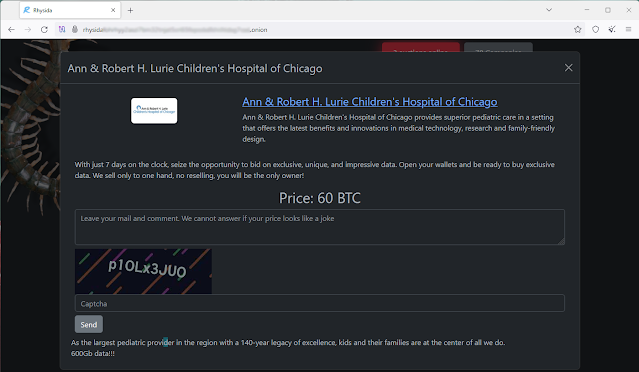
By Bill Toulas,  Bleeping Computer The Rhysida ransomware gang has claimed the cyberattack on Lurie Children's Hospital in Chicago at the start of the month. Lurie is a leading pediatric acute care institution in the U.S. that provides care to over 200,000 children annually. The cyberattack forced the healthcare provider to take its IT systems offline and postpone medical care in some cases. Email, phone, access to MyChart, and on-premises internet were all impacted. Ultrasound and CT scan results were rendered unavailable, patient service prioritization systems were taken down, and doctors were forced to switch to pen and paper for prescriptions. Today, the Rhysida ransomware gang has listed Lurie Children's on its extortion portal on the dark web, claiming to have stolen 600 GB of data from the hospital. Rhysida ransomware now offers to sell the stolen data for 60 BTC ($3,700,000) to a single buyer. The deadline was set to seven days, after which the data will either be sol...

Romanian hospital ransomware crisis attributed to third-party breach

Image
Emergency impacting more than 100 facilities appears to be caused by incident at software provider By Connor Jones,  The Register The Romanian national cybersecurity agency (DNSC) has pinned the outbreak of ransomware cases across the country's hospitals to an incident at a service provider. It said an unnamed service provider reported an issue prior to the flood of hospitals alerting the agency to the attacks. The service provider operates the Hipocrate Information System (HIS) – a multipurpose healthcare management platform used by hospitals across the country. All hospitals caught up in the ransomware scourge are thought to have been breached via the HIS. Per legal reporting obligations in Romania, service providers must inform the DNSC and national CSIRT of incidents that significantly impact the continuity of essential services. "We are exactly in the scenario of the Backmydata/Phobos ransomware incident that affected dozens of hospitals in Romania," the DNSC said t...

An Entire Canadian Town Is Being Extorted By Ransomware Cyber Criminals

Image
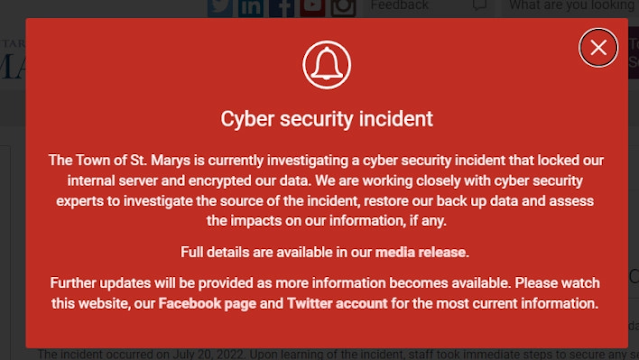
by Lane Babuder,  Hot Hardware Ransomware attacks have been on the rise. This time around, the small Ontario, Canada town of St. Marys has been targeted. The ransomware organization behind the attack seems to be LockBit. So far though, no ransom has been paid. The town itself claims that most city functions are still operational and staff are still working and getting paid. Upon visiting the official web site of the town visitors are greeted with a large red box containing the following quote. "The Town of St. Marys is currently investigating a cyber security incident that locked our internal server and encrypted our data. We are working closely with cyber security experts to investigate the source of the incident, restore our back up data, and assess impacts on our information, if any." "We have a skilled and knowledgeable team of Town staff, cyber security experts and legal counsel working around the clock to resolve any issues related to this incident. I have full con...

Digital security giant Entrust breached by ransomware gang

Image
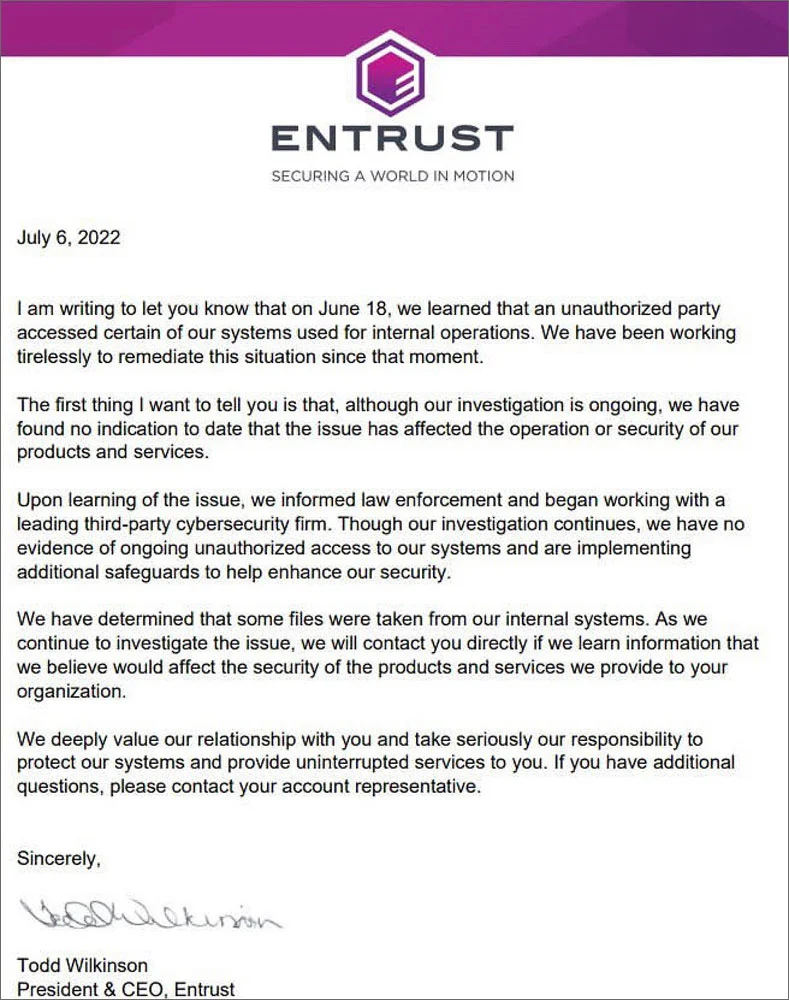
By Lawrence Abrams,  Bleeping Computer Digital security giant Entrust has confirmed that it suffered a cyberattack where threat actors breached their network and stole data from internal systems. Entrust is a security firm focused on online trust and identity management, offering a wide range of services, including encrypted communications, secure digital payments, and ID issuance solutions. Depending on what data was stolen, this attack could impact a large number of critical, and sensitive, organizations who use Entrust for identity management and authentication.  This includes US government agencies, such as the Department of Energy, Department of Homeland Security, the Department of the Treasury, the Department of Health & Human Services, the Department of Veterans Affairs, the Department of Agriculture, and many more.

MIT bets on deep learning to fight cybercrime

By Jurgita LapienytÄ—,  Cyber News Despite best efforts and innovation, cybercrime is on the rise. MIT scientists and leading network defenders urge to explore deep learning to secure systems. In the first quarter of 2022 alone, there were 404 publicly reported data breaches in the US. Ransomware breaches increased by 13% in a single year. “No wonder an increasing number of organizations are beginning to explore how deep learning, and its ability to mimic the human brain, can outsmart and outpace the world’s fastest and most dangerous cyber threats,” MIT Technology Review said in its research paper produced together with cybersecurity company Deep Instinct. MIT is looking at deep learning-driven malware prevention, hoping it could boost organizations in an innovation race against ransomware groups, enhancing their evasive capabilities, using sandbox detection or even adversarial artificial intelligence (AI.) Deep learning is the most advanced form of AI technology that uses neural n...

AstraLocker ransomware shuts down and releases decryptors

Image
By Sergiu Gatlan,  Bleeping Computer The threat actor behind the lesser-known AstraLocker ransomware told BleepingComputer they're shutting down the operation and plan to switch to cryptojacking. The ransomware's developer submitted a ZIP archive with AstraLocker decryptors to the VirusTotal malware analysis platform. BleepingComputer downloaded the archive and confirmed that the decryptors are legitimate and working after testing one of them against files encrypted in a recent AstroLocker campaign. While we only tested one decryptor that successfully decrypted files locked in one campaign, other decryptors in the archive are likely designed to decrypt files encrypted in previous campaigns. "It was fun, and fun things always end sometime. I'm closing the operation, decryptors are in zip files, clean. I will come back," AstraLocker's developer said. "I'm done with ransomware for now. I'm going in cryptojaking lol." While the developer did not ...

North Korean State-Sponsored Cyber Actors Use Maui Ransomware to Target the Healthcare and Public Health Sector

CISA, the Federal Bureau of Investigation (FBI), and the Department of the Treasury (Treasury) have released a joint Cybersecurity Advisory (CSA), North Korean State-Sponsored Cyber Actors Use Maui Ransomware to Target the Healthcare and Public Health Sector, to provide information on Maui ransomware, which has been used by North Korean state-sponsored cyber actors since at least May 2021 to target Healthcare and Public Health (HPH) Sector organizations.  CISA, FBI and Treasury urge network defenders to examine their current cybersecurity posture and apply the recommended mitigations in this joint CSA, which include: Train users to recognize and report phishing attempts. Enable and enforce multifactor authentication. Install and regularly update antivirus and antimalware software on all hosts. See North Korean State-Sponsored Cyber Actors Use Maui Ransomware to Target the Healthcare and Public Health Sector for Maui ransomware tactics, techniques, and procedures, indicators of comp...

Canadian Affiliated With NetWalker Ransomware Group Pleads Guilty to Hacking Charges

By Sophie Webster, Tech Times A Canadian who previously worked as an IT expert for the Canadian government has pleaded guilty to being a high-level hacker. He also admitted to being a member of a Russian cyber-crime group. 

Fake copyright infringement emails install LockBit ransomware

By Bill Toulas,  Bleeping Computer LockBit ransomware affiliates are using an interesting trick to get people into infecting their devices by disguising their malware as copyright claims. The recipients of these emails are warned about a copyright violation, allegedly having used media files without the creator's license. These emails demand that the recipient remove the infringing content from their websites, or they will face legal action. The emails, spotted by analysts at AhnLab, Korea, do not determine which files were unfairly used in the body and instead tell the recipient to download and open the attached file to see the infringement content. The attachment is a password-protected ZIP archive containing a compressed file, which in turn has an executable disguised as a PDF document, but in reality, is an NSIS installer. The reason for this wrapping and password protection is to evade detection from email security tools. If the victim opens the supposed "PDF" to lea...

Chinese hackers use ransomware as decoy for cyber espionage

By Bill Toulas,  Bleeping Computer Two Chinese hacking groups conducting cyber espionage and stealing intellectual property from Japanese and western companies are deploying ransomware as a decoy to cover up their malicious activities. Threat analysts from Secureworks say that the use of ransomware in espionage operations is done to obscure their tracks, make attribution harder, and create a powerful distraction for defenders. Finally, the exfiltration of the sensitive information is masked as financially-motivated attacks, which isn't the case with Chinese government-sponsored threat groups.

AstraLocker 2.0 infects users directly from Word attachments

By Bill Toulas,  Bleeping Computer A lesser-known ransomware strain called AstraLocker has recently released its second major version, and according to threat analysts, its operators engage in rapid attacks that drop its payload directly from email attachments. This approach is quite unusual as all the intermediate steps that typically characterize email attacks are there to help evade detection and minimize the chances of raising red flags on email security products. According to ReversingLabs, which has been following AstraLocker operations, the adversaries don’t seem to care about reconnaissance, evaluation of valuable files, and lateral network movement. Instead, they are performing "smash-n-grab" attacks to his immediately hit with maximum force aiming for a quick payout.

Proofpoint Discovers Potentially Dangerous Microsoft Office 365 Functionality that can Ransom Files Stored on SharePoint and OneDrive

Ransomware attacks have traditionally targeted data across endpoints or network drives. Until now, IT and security teams felt that cloud drives would be more resilient to ransomware attacks. After all, the now-familiar “AutoSave” feature along with versioning and the good old recycle bin for files should have been sufficient as backups. However, that may not be the case for much longer.  Proofpoint has discovered a potentially dangerous piece of functionality in Office 365 or Microsoft 365 that allows ransomware to encrypt files stored on SharePoint and OneDrive in a way that makes them unrecoverable without dedicated backups or a decryption key from the attacker.   Our research focused on two of the most popular enterprise cloud apps - SharePoint Online and OneDrive within the Microsoft 365 and Office 365 suites and shows that ransomware actors can now target organizations’ data in the cloud and launch attacks on cloud infrastructure.    Read on!

Ransomware Group Debuts Searchable Victim Data

By  Krebs On Security Cybercrime groups that specialize in stealing corporate data and demanding a ransom not to publish it have tried countless approaches to shaming their victims into paying. The latest innovation in ratcheting up the heat comes from the ALPHV/BlackCat ransomware group, which has traditionally published any stolen victim data on the Dark Web. Today, however, the group began publishing individual victim websites on the public Internet, with the leaked data made available in an easily searchable form. ALPHV recently announced on its victim shaming and extortion website that it had hacked a luxury spa and resort in the western United States. Sometime in the last 24 hours, ALPHV published a website with the same victim’s name in the domain, and their logo on the homepage. The website claims to list the personal information of 1,500 resort employees, and more than 2,500 residents at the facility. At the top of the page are two “Check Yourself” buttons, one for employe...

Microsoft: Exchange servers hacked to deploy BlackCat ransomware

Image
By Sergiu Gatlan,  Bleeping Computer Microsoft says BlackCat ransomware affiliates are now attacking Microsoft Exchange servers using exploits targeting unpatched vulnerabilities. In at least one incident that Microsoft's security experts observed, the attackers slowly moved through the victim's network, stealing credentials and exfiltrating information to be used for double extortion. Two weeks after the initial compromise using an unpatched Exchange server as an entry vector, the threat actor deployed BlackCat ransomware payloads across the network via PsExec. "While the common entry vectors for these threat actors include remote desktop applications and compromised credentials, we also saw a threat actor leverage Exchange server vulnerabilities to gain target network access," the Microsoft 365 Defender Threat Intelligence Team said. Although it didn't mention the Exchange vulnerability used for initial access, Microsoft links to a security advisory from March 2...