Posts

Showing posts with the label Facebook

Hackers Attack British Army's Twitter, YouTube And Facebook Accounts

By Murtuza Merchant, Benzinga Crypto scammers briefly hacked the official Twitter, YouTube and Facebook accounts of the British army to promote certain non-fungible token (NFT) collections and phishing scams. The press office of the Ministry of Defense confirmed Monday that it was aware of the breach and that an investigation was underway: "The Army takes information security extremely seriously and is resolving the issue. Until their investigation is complete it would be inappropriate to comment further." The official social media accounts were subsequently restored, while scam and phishing links were deleted. It remains unclear who was behind the breach, how many victims were affected and the quantum of funds lost to phishing schemes. According to screenshots posted by Twitter users, hackers promoted at least two derivates of fraudulent NFT collections of “The Possessed” and “BAPESCLAN.” Hackers also pinned a fake NFT mint of “The Possessed” NFT collection, with phishing li...

Has Your Facebook Account Been Hacked? You May Never Get it Back

The problem is, you can't speak to a real human being to explain what happened and ask for help. By Matthew Humphries, PC Mag Have you ever wondered what happens if your Facebook account gets hacked? It turns out your account could be lost forever and there's absolutely nothing you can do about it. That's the ordeal exercise physiologist Emily Cordes is currently experiencing . Last week, she decided to access Facebook Marketplace and discovered she was logged out of her Facebook account. Her login credentials no longer worked and the password recovery process failed to send a verification code. Then she noticed the primary email address associated with the account was no longer hers, confirming she'd been hacked. The person in control of the account had enabled two-factor authentication, then started posting spammy ads for Alaskan crab meat, which led to the account being suspended. Cordes now faces a race against time to regain control of her account in the 30-day per...

Password safety: How do hackers steal your information?

By Rich DeMuro, Nexstar Media Wire Ever wonder how hackers get your password and gain access to your account? Recent research has identified several major ways: Password theft Password guessing Unauthorized password resetting or bypass “The biggest reason why people hate passwords is they’re all being told that they all need to be longer and longer and more complex,” started Roger Grimes, a Data-Driven Defense Evangelist at security awareness training company KnowBe4. He says phishing emails are a top way hackers get our passwords. You’ve seen them before — they say your Netflix account is about to be deactivated, your Facebook account has a copyright issue or something needs to be fixed with your Instagram. They trick us into handing over our information by making us log into a page that looks like the real thing but instantly sends our username and password to hackers, who immediately take over our accounts. Another way your password gets out into the wild: when a website is hack...

Security Warning For Facebook Users Who Login With Gmail OAuth Code

By Gordon Kelly, Forbes How do you sign into services? Because a newly disclosed Facebook exploit might change how you go about it in future... In an eye-opening blog post, security researcher Youssef Sammouda has revealed that chaining Gmail's OAuth authentication code with vulnerabilities in Facebook enabled him to hijack Facebook accounts when users logged in with their Gmail credentials. Speaking to The Daily Swing, Sammouda explained that he was able to use redirects in Google OAuth and chain them with elements of Facebook's logout, checkpoint and sandbox systems to break into accounts. He explained that while he demonstrated the proof of concept with Gmail credentials, "it was possible to target all Facebook users" Sammouda says Facebook paid him a $44,625 'bug bounty' for his disclosure of this vulnerability in February. Facebook subsequently patched it in March, though it was only made public this week. And while not directly responsible for the exploi...

What is ‘New Profile Pic’ app? Is it safe to use? Cybersecurity experts weigh in

Image
By Geoff Herbert, Penn Live If you’ve seen new Facebook profile pictures that look like a painting or cartoon, then you’ve probably noticed they all appear to come from a website and app called “New Profile Pic.” New Profile Pic, also sometimes written as one word “NewProfilePic,” allows users to submit photos of themselves for an “AI-driven” update that makes them look like works of art. The free app is currently No. 1 on the Apple Store and has exploded in popularity on social media this month. But some have also questioned its safety after some claimed the app “takes all your information and sends it to Moscow” as part of a Russian malware scam. The Daily Mail further suggested the app had Kremlin ties because it was developed by a tech company “overlooking the Moscow River three miles from Red Square,” but is that true? According to fact-checking website Snopes , New Profile Pic was created by a mobile development group called Informe Laboratories, Inc. , and copyrighted by Liner...

Fighting Fake EDRs With ‘Credit Ratings’ for Police

Image
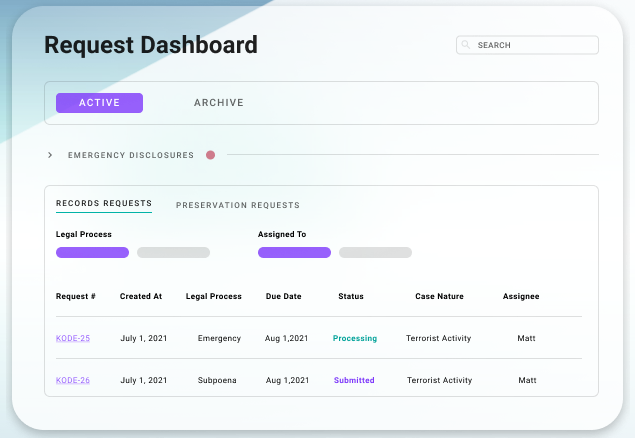
By  KrebsOnSecurity When KrebsOnSecurity recently explored how cybercriminals were using hacked email accounts at police departments worldwide to obtain warrantless Emergency Data Requests (EDRs) from social media firms and technology providers, many security experts called it a fundamentally unfixable problem. But don’t tell that to Matt Donahue, a former FBI agent who recently quit the agency to launch a startup that aims to help tech companies do a better job screening out phony law enforcement data requests — in part by assigning trustworthiness or “credit ratings” to law enforcement authorities worldwide. A sample Kodex dashboard Image: Kodex.us Donahue is co-founder of Kodex , a company formed in February 2021 that builds security portals designed to help tech companies “manage information requests from government agencies who contact them, and to securely transfer data & collaborate against abuses on their platform.” The 30-year-old Donahue said he left the FBI in April ...

Easiest way to see if your Gmail, Facebook or iCloud ID has been hacked

By Jona Jaupi, The Sun With cybercrime on the rise, it’s important to know if your information has been breached – here’s how. Today, cybercriminals target our data in a wide variety of ways: fake texts, malware-laden links, and even fraudulent mail that impersonates government officials. Sometimes, cyberattacks can be so discreet that you have no idea your device is even affected. Hackers can target portals of information like your Gmail, Facebook, and iCloud accounts. Through these accounts, they can then access sensitive information like bank details. However, there are certain signs you can keep your eyes open for – and the sooner you learn these red flags, the quicker you can tackle them. If your phone, laptop, or desktop starts acting glitchy or sluggish, that could mean you have been hacked. Similarly, if your device is getting inundated with fake warnings or suspicious-looking browser pop-ups, you may be a victim of a malware attack. Another tell-tale sign is if your browser is...