Posts

Showing posts with the label Microsoft 365

Microsoft says massive Azure outage was caused by DDoS attack

Image
By Sergiu Gatlan,  Bleeping Computer Microsoft confirmed today that a nine-hour outage on Tuesday, which took down and disrupted multiple Microsoft 365 and Azure services worldwide, was triggered by a distributed denial-of-service (DDoS) attack. Redmond says the outage impacted Microsoft Entra, some Microsoft 365 and Microsoft Purview services (including Intune, Power BI, and Power Platform), as well as Azure App Services, Application Insights, Azure IoT Central, Azure Log Search Alerts, Azure Policy, and the Azure portal. The company confirmed in a mitigation statement published today that the root cause behind yesterday's outage was a DDoS attack, although it has yet to link it to a specific threat actor. "While the initial trigger event was a Distributed Denial-of-Service (DDoS) attack, which activated our DDoS protection mechanisms, initial investigations suggest that an error in the implementation of our defenses amplified the impact of the attack rather than mitigating i...

Major Microsoft 365 outage caused by Azure configuration change

Image
By Sergiu Gatlan,  Bleeping Computer Microsoft says an Azure configuration change caused a major Microsoft 365 outage on Thursday, affecting customers across the Central US region. This massive outage started around 6:00 PM EST and prevented users from accessing various Microsoft 365 apps and services. The list of services impacted by the outage includes Microsoft Defender , Intune, Teams, PowerBI, Fabric, OneNote, OneDrive for Business, SharePoint Online, Windows 365, Viva Engage, Microsoft Purview, and the Microsoft 365 admin center. Xbox Support confirmed that the Xbox Live service was also hit by the issue, saying gamers had problems logging into their accounts. Throughout the outage, Downdetector has received tens of thousands of service issue reports, with affected Xbox users experiencing server connection issues and saying they couldn't log in. After acknowledging the outage, Microsoft said, "We're working on rerouting the impacted traffic to alternate systems to ...

Fake Google Chrome errors trick you into running malicious PowerShell scripts

Image
By Bill Toulas,  Bleeping Computer A new malware distribution campaign uses fake Google Chrome, Word, and OneDrive errors to trick users into running malicious PowerShell "fixes" that install malware. The new campaign was observed being used by multiple threat actors, including those behind ClearFake, a new attack cluster called ClickFix, and the TA571 threat actor, known for operating as a spam distributor that sends large volumes of email, leading to malware and ransomware infections. Previous ClearFake attacks utilize website overlays that prompt visitors to install a fake browser update that installs malware. Threat actors also utilize JavaScript in HTML attachments and compromised websites in the new attacks. However, now the overlays display fake Google Chrome, Microsoft Word, and OneDrive errors. These errors prompt the visitor to click a button to copy a PowerShell "fix" into the clipboard and then paste and run it in a Run: dialog or PowerShell prompt. ...

AT&T delays Microsoft 365 email delivery due to spam wave

Image
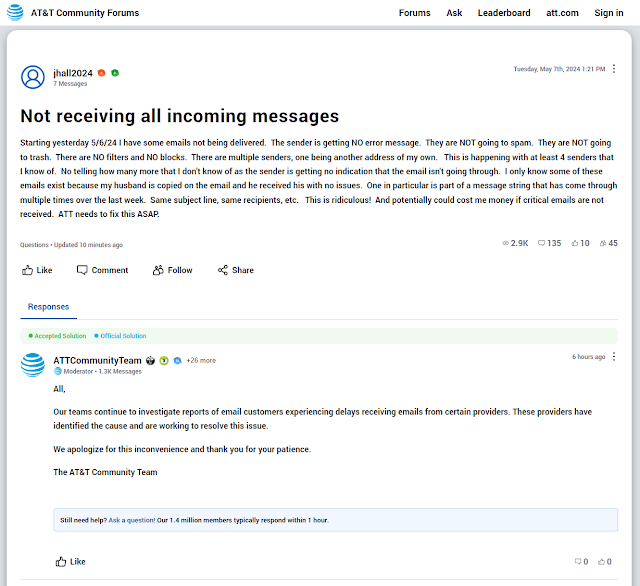
By Lawrence Abrams, Bleeping Computer AT&T's email servers are blocking connections from Microsoft 365 due to a "high volume" spam wave originating from Microsoft's service. Starting on Monday, AT&T customers began reporting they could no longer receive email from Microsoft 365 email addresses. When Microsoft 365 customers attempted to email an address at @att.com, @sbcglobal.net, or @bellsouth.com, AT&T servers would refuse the connection and not accept the email for delivery.

Microsoft warns Gmail blocks some Outlook email as spam, shares fix

Image
By Sergiu Gatlan,  Bleeping Computer Microsoft has confirmed that some Outlook.com users are experiencing issues with emails being blocked and marked as spam when trying to email Gmail accounts. This known issue only impacts users with Outlook.com country domains, according to a support document published by Redmond on Tuesday. Affected Outlook users are being told in follow-up emails from Gmail's servers that their messages were suspicious and have been stopped from reaching the recipient's inbox. "Remote server returned message detected as spam [..]. Gmail has detected that this message is likely suspicious due to the very low reputation of the sending domain. To best protect our users from spam, the message has been blocked," the replies from Gmail's mail server (mx.google.com) explain. Google's support website says that it's very likely that only a subset of these messages are being blocked because they have "a strong likelihood of being spam....

New MFA-bypassing phishing kit targets Microsoft 365, Gmail accounts

Image
By Bill Toulas,  Bleeping Computer Cybercriminals have been increasingly using a new phishing-as-a-service (PhaaS) platform named 'Tycoon 2FA' to target Microsoft 365 and Gmail accounts and bypass two-factor authentication (2FA) protection. Tycoon 2FA was discovered by Sekoia analysts in October 2023 during routine threat hunting, but it has been active since at least August 2023, when the Saad Tycoon group offered it through private Telegram channels. The PhaaS kit shares similarities with other adversary-in-the-middle (AitM) platforms, such as Dadsec OTT, suggesting possible code reuse or a collaboration between developers. In 2024, Tycoon 2FA released a new version that is stealthier, indicating a continuous effort to improve the kit. Currently, the service leverages 1,100 domains and has been observed in thousands of phishing attacks.

Massive Microsoft 365 outage caused by faulty ECS deployment

By Sergiu Gatlan,  Bleeping Computer In a preliminary post-incident report, Microsoft has revealed that this week's 5-hour-long Microsoft 365 worldwide outage was triggered by a faulty Enterprise Configuration Service (ECS) deployment that led to cascading failures and availability impact across multiple regions. ECS is an internal central configuration repository designed to enable Microsoft services to make wide-scope dynamic changes across multiple services and features, as well as targeted ones such as specific configurations per tenant or user. What initially started like a minor Microsoft Teams outage ended up expanding downstream to multiple Microsoft 365 services with Teams integration that also leverage ECS, including Exchange Online, Windows 365, and Office Online. As a result, users worldwide began reporting that they could not use Microsoft Teams and multiple Microsoft 365 services or features. "This issue affected the users' ability to connect to the Microsoft...

Microsoft: Phishing bypassed MFA in attacks against 10,000 orgs

Image
By Sergiu Gatlan,  Bleeping Computer Microsoft says a massive series of phishing attacks has targeted more than 10,000 organizations starting with September 2021, using the gained access to victims' mailboxes in follow-on business email compromise (BEC) attacks. The threat actors used landing pages designed to hijack the Office 365 authentication process (even on accounts protected by multifactor authentication (MFA) by spoofing the Office online authentication page. In some of the observed attacks, the potential victims were redirected to the landing pages from phishing emails using HTML attachments that acted as gatekeepers ensuring the targets were being sent via the HTML redirectors. After stealing the targets' credentials and their session cookies, the threat actors behind these attacks logged into the victims' email accounts. They subsequently used their access in business email compromise (BRC) campaigns targeting other organizations. "A large-scale phishing cam...

Toll fraud malware continues to evolve, says Microsoft: Here's how Android users can protect themselves

Toll fraud, one of the most prevalent types of Android malware, continues to evolve. In a blog post on Thursday, the Microsoft 365 Defender Research Team revealed the details of this threat - how it operates, how analysts can better identify such threats, and how Android security can be improved to mitigate this threat. According to Microsoft's blog, toll fraud malware is a subcategory of billing fraud in which malicious applications subscribe users to premium services without their knowledge or consent. The malware accounted for 34.8% of installed Potentially Harmful Application (PHA) from the Google Play Store in the first quarter of 2022, ranking second only to spyware. The malware has unique behaviors. While SMS or call frauds use a simple attack flow to send messages or calls to a premium number, toll fraud has a complex multi-step attack flow that malware developers continue to improve. Microsoft security researchers observed new capabilities related to how this threat target...

Microsoft 365 credentials targeted in new fake voicemail campaign

By Bill Toulas,  Bleeping Computer A new phishing campaign has been targeting U.S. organizations in the military, security software, manufacturing supply chain, healthcare and pharmaceutical sectors to steal Microsoft Office 365 and Outlook credentials. The operation is ongoing and the threat actor behind it uses fake voicemail notifications to lure victims into opening a malicious HTML attachment. Campaign overview According to researchers at cloud security company ZScaler, the recently discovered campaign shares tactics, techniques, and procedures (TTPs) with another operation analyzed in mid-2020. The threat actors leverage email services in Japan to route their messages and spoof the sender's address, making it look like the emails come from an address belonging to the targeted organization. The email has an HTML attachment that uses a music note character in the naming to make it appear as if the file is a sound clip. In reality, the file contains obfuscated JavaScript code th...

Microsoft 365 outage affects Microsoft Teams and Exchange Online

By Sergiu Gatlan,  Bleeping Computer An ongoing outage affects multiple Microsoft 365 services, with customers worldwide reporting delays, sign-in failures, and issues accessing their accounts. Starting with Monday, June 20, at 11:00 PM UTC, users have been experiencing and reporting being asked to re-login, emails stuck in queues and not getting delivered, while others say they were unable to access their Exchange Online mailboxes via any connection method they tried.  The affected services include the Exchange Online hosted email platform for businesses and the Microsoft Teams communication platform, as well as SharePoint Online, the Graph API, and Universal Print. "Users may encounter delays and experience failures when accessing some M365 services," Microsoft explained in a service alert sent to Microsoft 365 customers. "Users may also experience failures when using search functions within the impacted services." Microsoft says it is currently redirecting Micros...

Proofpoint Discovers Potentially Dangerous Microsoft Office 365 Functionality that can Ransom Files Stored on SharePoint and OneDrive

Ransomware attacks have traditionally targeted data across endpoints or network drives. Until now, IT and security teams felt that cloud drives would be more resilient to ransomware attacks. After all, the now-familiar “AutoSave” feature along with versioning and the good old recycle bin for files should have been sufficient as backups. However, that may not be the case for much longer.  Proofpoint has discovered a potentially dangerous piece of functionality in Office 365 or Microsoft 365 that allows ransomware to encrypt files stored on SharePoint and OneDrive in a way that makes them unrecoverable without dedicated backups or a decryption key from the attacker.   Our research focused on two of the most popular enterprise cloud apps - SharePoint Online and OneDrive within the Microsoft 365 and Office 365 suites and shows that ransomware actors can now target organizations’ data in the cloud and launch attacks on cloud infrastructure.    Read on!

Russian state hackers swap malware with cloud-based attacks

By Vilius Petkauskas,  Cybernews Russian adversaries increasingly focus on targeting the cloud environment, Crowdstrike’s Global Threat Report on Cloud Security revealed. Fancy Bear, a Russian adversary associated with Russia’s Main Intelligence Directorate (GRU), used to rely on malware-based spear-phishing attacks, the report claims. However, with their tactics exposed by the US Department of Justice (DoJ), hackers have refocused their attention on cloud service providers. Since Fancy Bear’s primary source of intelligence comes from various credential harvesting practices that allow penetrating target organizations and individuals, it’s no surprise that the main targets are cloud-based email providers. According to the report, Fancy Bear focused their attention on service providers such as Microsoft 365, Google’s GSuite, as well as webmail providers that individuals usually use. Meanwhile, Cozy Bear, Russia’s state-sponsored hacker group controlled by the Federal Security service...

New Microsoft Office zero-day used in attacks to execute PowerShell

By Ionut Ilascu , Bleeping Computer Security researchers have discovered a new Microsoft Office zero-day vulnerability that is being used in attacks to execute malicious PowerShell commands via Microsoft Diagnostic Tool (MSDT) simply by opening a Word document. The vulnerability, which has yet to receive a tracking number and is referred to by the infosec community as 'Follina,' is leveraged using malicious Word documents that execute PowerShell commands via the MSDT. This new Follina zero-day opens the door to a new critical attack vector leveraging Microsoft Office programs as it works without elevated privileges, bypasses Windows Defender detection, and does not need macro code to be enabled to execute binaries or scripts.

Microsoft detects massive surge in Linux XorDDoS malware activity

Image
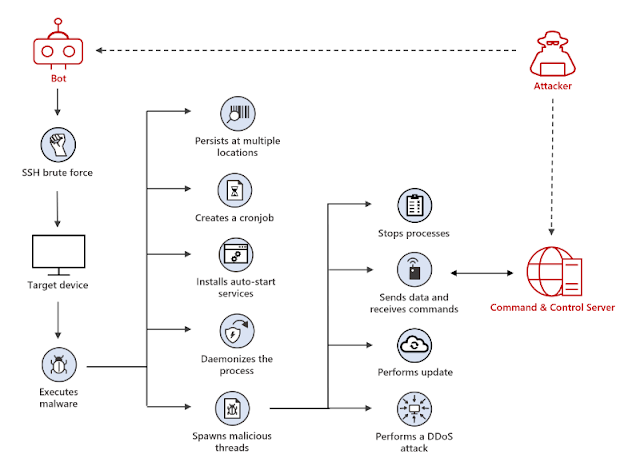
By Sergiu Gatlan, Bleeping Computer A stealthy and modular malware used to hack into Linux devices and build a DDoS botnet has seen a massive 254% increase in activity during the last six months, as Microsoft revealed today. This malware (active since at least 2014) is known as XorDDoS (or XOR DDoS) due to its use of XOR-based encryption when communicating with command-and-control (C2) servers and being employed to launch distributed denial-of-service (DDoS) attacks. As the company revealed, the botnet's success is likely due to its extensive use of various evasion and persistence tactics which allow it to remain stealthy and hard to remove. "Its evasion capabilities include obfuscating the malware's activities, evading rule-based detection mechanisms and hash-based malicious file lookup, as well as using anti-forensic techniques to break process tree-based analysis," Microsoft 365 Defender Research Team said. "We observed in recent campaigns that XorDdos hides m...

Microsoft: Windows Autopatch steals the 'fun' from Patch Tuesdays

Image
Microsoft announced that Windows Autopatch, a service designed to automatically keep Windows and Office software up to date, will be released in July 2022. Windows Autopatch is a new managed service offered for free to all Microsoft customers who already have a Windows 10/11 Enterprise E3 or above license. "This service will keep Windows and Office software on enrolled endpoints up-to-date automatically, at no additional cost. The second Tuesday of every month will be 'just another Tuesday'," promised Lior Bela, a Sr. Product Marketing Manager at Microsoft. "Windows Autopatch manages all aspects of deployment groups for Windows 10 and Windows 11 quality and feature updates, drivers, firmware, and Microsoft 365 Apps for enterprise updates." It moves the update orchestration from organizations to Microsoft, with the burden of planning the Update process (including rollout and sequencing) no longer on the orgs' IT teams. Windows Autopatch works with al...