Posts

Showing posts with the label Linux

New Windows Subsystem for Linux malware steals browser auth cookies

Image
By Ionut Ilascu, Bleeping Computer Hackers are showing an increased interest in the Windows Subsystem for Linux (WSL) as an attack surface as they build new malware, the more advanced samples being suitable for espionage and downloading additional malicious modules. As the name of the feature implies, WSL allows running native Linux binaries to run on Windows in an environment that emulates the Linux kernel. WSL-based malware samples discovered recently rely on open-source code that routes communication through the Telegram messaging service and gives the threat actor remote access to the compromised system. RATs and shells Malicious Linux binaries for WSL were first discovered over a year ago, with researchers at Lumen Technologies’ Black Lotus Labs publishing a report on this new type of threat in September 2021. Since then, their number has grown constantly, with all variants enjoying low detection rates, despite being based on publicly available code. Black Lotus Labs researchers ...
Microsoft detects massive surge in Linux XorDDoS malware activity

Image
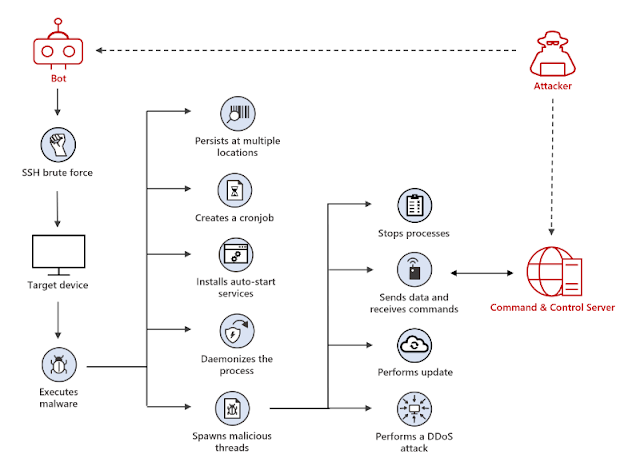
By Sergiu Gatlan, Bleeping Computer A stealthy and modular malware used to hack into Linux devices and build a DDoS botnet has seen a massive 254% increase in activity during the last six months, as Microsoft revealed today. This malware (active since at least 2014) is known as XorDDoS (or XOR DDoS) due to its use of XOR-based encryption when communicating with command-and-control (C2) servers and being employed to launch distributed denial-of-service (DDoS) attacks. As the company revealed, the botnet's success is likely due to its extensive use of various evasion and persistence tactics which allow it to remain stealthy and hard to remove. "Its evasion capabilities include obfuscating the malware's activities, evading rule-based detection mechanisms and hash-based malicious file lookup, as well as using anti-forensic techniques to break process tree-based analysis," Microsoft 365 Defender Research Team said. "We observed in recent campaigns that XorDdos hides m...

Google Patches Dozens Of Vulnerabilities In Chrome, Update ASAP

Image
By Lane Babuder, Hot Hardware Another day another vulnerability. This one's a doozy, though. The Stable Channel for the desktop edition of Chrome had an update on April 26, 2022. That update includes no less than 30 security fixes, half a dozen of which are rated as "High" severity flaws. The release notes for Google's Chrome v101.0.4951.41 for Windows, Mac, and Linux has a long list of bug fixes; you can view it here . However, there's also an interesting statement in that page. "Note: Access to bug details and links may be kept restricted until a majority of users are updated with a fix. We will also retain restrictions if the bug exists in a third party library that other projects similarly depend on, but haven’t yet fixed." Effectively the the non-developer translation of the quote above is that these are serious enough to keep the details hidden from the public to avoid bad actors pouncing on them with exploits. We can tell you a good portion of the...

Open source 'Package Analysis' tool finds malicious npm, PyPI packages

Image
By Ax Sharma, Bleeping Computer The Open Source Security Foundation (OpenSSF), a Linux Foundation-backed initiative has released its first prototype version of the 'Package Analysis' tool that aims to catch and counter malicious attacks on open source registries. In a pilot run that lasted less than a month, the open source project released on GitHub, was able to identify over 200 malicious npm and PyPI packages. Project aims to combat malware in open source registries This week, OpenSSF released its initial prototype version of the 'Package Analysis' project on GitHub. The project repository contains tools that analyze open source packages, particularly, to hunt for malicious npm and PyPI packages. "The Package Analysis project seeks to understand the behavior and capabilities of packages available on open source repositories: what files do they access, what addresses do they connect to, and what commands do they run?" explain Caleb Brown and David A. Wheeler...